Monday, 9 December 2024

HOW TECHNOLOGY WILL TRANSFORM THE WORLD IN FUTURE

The future of the world will be profoundly shaped by technology, leading to significant changes in nearly every aspect of our lives. These transformations will be driven by advances in several key areas, including artificial intelligence (AI), automation, biotechnology, renewable energy, and space exploration. Below are some of the potential changes we may see in the future


1. Work and Employment

  • Automation & AI: Many manual, repetitive tasks will be replaced by robots and AI, leading to greater efficiency and productivity. While some jobs may be lost, new ones in AI management, robotics maintenance, and data analysis will emerge. The nature of work will shift toward more creative, strategic, and human-centered tasks.
  • Remote Work: Virtual reality (VR) and augmented reality (AR) technologies will make remote work even more immersive, allowing people to work from anywhere while interacting in virtual spaces that feel like real offices.
  • Gig Economy Expansion: The gig economy will continue to grow, with more people working as freelancers or contractors thanks to platforms enabled by AI and digital tools.

2. Healthcare

  • Personalized Medicine: Advances in genomics and biotechnology will allow for highly personalized medical treatments tailored to an individual’s genetic makeup. Precision medicine could greatly improve the efficacy of treatments and reduce side effects.
  • AI in Diagnostics: AI-powered tools will revolutionize diagnostics, enabling faster, more accurate identification of diseases like cancer, neurological disorders, and heart conditions. AI might also assist doctors in making treatment decisions based on vast datasets.
  • Extended Lifespan: Technological advances in regenerative medicine, stem cell therapy, and anti-aging research could significantly increase life expectancy, possibly extending human life by decades or more.   

3. Transportation

  • Autonomous Vehicles: Self-driving cars, trucks, and drones will ransform transportation. They will reduce accidents, improve traffic flow, and make travel more efficient. The need for human drivers will decline, while new industries like vehicle software development will emerge.
  • Hyperloop and Electric Vehicles: High-speed travel through systems like the Hyperloop could revolutionize long-distance travel. Meanwhile, the widespread adoption of electric vehicles (EVs) will reduce reliance on fossil fuels and help mitigate climate change.
  • Urban Mobility: Cities will see more interconnected, on-demand transportation options, such as autonomous shuttles, e-scooters, and flying taxis, reducing congestion and improving access to public transportation.

4. Education

  • AI Tutors and Personalized Learning: AI can provide personalized learning experiences, adapting to the individual needs and pace of each student. Virtual classrooms and tutors powered by AI will become commonplace, making education more accessible.
  • Lifelong Learning: As the pace of technological change accelerates, people will need to constantly upskill. Online learning platforms and digital credentials will become integral to ongoing professional development.
  • Global Access to Education: Advances in digital technologies will enable people from all over the world to access high-quality education regardless of location, bridging gaps in global education systems.

5. Entertainment

  • Immersive Experiences: Virtual reality (VR) and augmented reality (AR) will create fully immersive entertainment experiences, allowing users to engage with movies, video games, and even live events in entirely new ways.
  • AI in Content Creation: AI will assist in creating music, films, and art, enabling artists to collaborate with machines for new forms of creative expression. AI tools could also help personalize content recommendations, creating more tailored experiences for users.
  • Holograms and Virtual Concerts: With the advancement of holographic technology, virtual concerts, events, and even holographic performances of deceased stars may become common forms of entertainment.

6. Environment and Sustainability

  • Renewable Energy: The world will shift away from fossil fuels to renewable sources of energy, such as solar, wind, and hydrogen, thanks to advancements in energy storage, efficiency, and clean energy technology.
  • Climate Engineering: Technologies such as carbon capture and geoengineering could help mitigate climate change by removing excess CO2 from the atmosphere and cooling the planet.
  • Smart Cities: Cities will become more sustainable and efficient with the integration of IoT (Internet of Things) devices, which will manage everything from traffic to energy usage. These smart technologies will improve urban living while reducing environmental impact.

7. Society and Lifestyle

  • Digital Privacy & Security: With the rise of surveillance technologies, maintaining privacy will become more challenging. However, advanced encryption and AI-driven security systems will also be developed to protect personal data and prevent cybercrime.
  • Social Impact of AI: AI will play an increasing role in decision-making, from hiring to law enforcement, raising ethical questions around bias, fairness, and accountability. Policies will need to adapt to ensure responsible AI usage.
  • New Social Dynamics: As technology continues to evolve, people will have more opportunities for virtual interaction, potentially changing how relationships are formed and maintained. Social media platforms will continue to influence political and cultural discussions on a global scale.

8. Space Exploration

  • Colonization of Mars: Space exploration will open new frontiers, with plans for colonizing Mars becoming more feasible due to advancements in propulsion, life support systems, and sustainable habitats.
  • Space Tourism: Companies like SpaceX and Blue Origin are making space tourism a reality, allowing ordinary people to experience space travel, leading to a new industry centered around space-based tourism.
  • Resource Mining: Space exploration could also lead to the mining of asteroids for valuable materials, such as rare metals, which would alleviate resource scarcity on Earth.

9. Ethical and Political Considerations

  • Technology Regulation: Governments will need to address new challenges related to privacy, AI ethics, and cybersecurity. International agreements and regulations may be needed to manage the global impact of emerging technologies.
  • Inequality: As technology advances, there is a risk that the benefits may not be equally distributed. Ensuring access to technology for all, regardless of socioeconomic status, will be a critical challenge.

Sunday, 1 December 2024

HOW PHYSICS IMPACT ON LIVES OF ANIMALS

 Physics plays a significant role in the lives of animals by influencing their behavior, survival mechanisms, and interactions with their environment. Here are some key ways physics impacts animals:

1. Movement and Locomotion

  • Mechanics of Movement: Animals use principles of physics like force, friction, and energy transfer to walk, run, swim, or fly. For example, birds use the physics of lift and drag for flight, while fish rely on hydrodynamics to glide through water.
  • Energy Efficiency: Animals optimize their movements to conserve energy, such as the streamlined shapes of dolphins and penguins reducing drag in water.
                            

2. Sensing and Navigation

  • Sound Waves: Animals like bats and dolphins use echolocation, a physics-based principle of sound wave reflection, to locate prey and navigate in darkness or murky waters.
  • Electromagnetic Fields: Some animals, like migratory birds and sea turtles, sense Earth's magnetic fields (geomagnetism) to navigate long distances.
  • Light and Vision: Physics of light determines how animals see their surroundings. For example, bees perceive ultraviolet light, which helps them find nectar-rich flowers.


3. Adaptation to Forces

  • Structural Physics: Animals develop structures to counteract forces like gravity and pressure. For example, strong legs in elephants distribute their weight, while deep-sea creatures withstand high-pressure environments.
  • Elastic Energy: Kangaroos use the elasticity in their tendons to store and release energy efficiently for hopping.

4. Temperature Regulation

  • Heat Transfer: Animals regulate body temperature using conduction, convection, and radiation. Desert animals, for instance, minimize heat absorption by having reflective or light-colored surfaces.
  • Thermal Adaptations: Penguins huddle together to conserve heat, minimizing heat loss through conduction and maximizing body warmth.

5. Predator-Prey Dynamics

  • Camouflage and Optics: Many animals use light reflection and refraction principles for camouflage, blending into their environments to avoid predators or ambush prey.
  • Acceleration and Speed: Predators like cheetahs exploit physics by optimizing their bodies for acceleration and top speeds during hunts.

6. Communication

  • Wave Propagation: Many animals communicate using sound waves. Whales, for example, use low-frequency calls that travel long distances underwater due to the physics of sound propagation in dense media.
  • Vibrations: Insects like crickets communicate by creating vibrations on surfaces, utilizing wave mechanics.


Conclusion

Physics is deeply intertwined with animal biology and behavior, influencing how animals move, communicate, and adapt to their environments. By understanding these physical principles, researchers can better protect species and study their fascinating lives.

How Modern Technology is Changing Education

 Modern technology is transforming education in profound ways, making it more accessible, interactive, and personalized

The response provided highlights various aspects, such as the use of e-learning platforms, VR/AR tools, personalized learning systems, and collaborative cloud-based technologies, reflecting how education is evolving to meet the demands of the digital age.


1. Access to Education

  • E-learning Platforms: Platforms like Khan Academy, Coursera, and Udemy provide courses on almost any subject, making quality education accessible globally.
  • Remote Learning: Video conferencing tools like Zoom and Microsoft Teams enable distance learning, allowing students to attend classes from anywhere in the world.
  • Open Educational Resources (OER): Free access to textbooks, research papers, and multimedia resources lowers the cost of education.

2. Personalized Learning

  • Artificial Intelligence (AI): Adaptive learning systems, such as Duolingo or DreamBox, customize content and pace to suit individual student needs.
  • Data Analytics: Educators can track student performance in real time and adjust teaching strategies accordingly.
                                             

3. Interactive Learning

  • Gamification: Apps and platforms integrate games into learning, making subjects like math and science more engaging.
  • Virtual and Augmented Reality (VR/AR): Tools like Google Expeditions or Oculus allow immersive experiences, such as exploring historical sites or conducting virtual science experiments.

4. Collaboration and Communication

  • Cloud-based Tools: Platforms like Google Workspace allow students and teachers to collaborate on projects and assignments in real time.
  • Global Classrooms: Technology connects classrooms worldwide, fostering cultural exchange and global perspectives.

5. Skill Development

  • Coding and Digital Literacy: Online platforms like Scratch and Code.org help students learn programming and other digital skills from a young age.
  • Simulation Tools: Professionals-in-training, such as medical or engineering students, use simulation software to practice skills in a risk-free environment.

6. Flexibility and Inclusivity

  • Asynchronous Learning: Students can access recorded lectures and materials at their convenience, accommodating different schedules and learning speeds.
  • Assistive Technologies: Tools like screen readers, speech-to-text software, and captioning systems make education accessible to students with disabilities.

7. Challenges and Considerations

  • Digital Divide: Not all students have equal access to devices and the internet, creating a gap in educational opportunities.
  • Distraction and Screen Time: Managing focus and ensuring healthy digital habits are growing concerns.
  • Teacher Training: Educators need support and training to effectively use new technologies.
             

Conclusion

Modern technology has democratized education and enhanced its effectiveness, but it requires careful implementation to address equity and accessibility challenges. By leveraging its potential responsibly, education can continue to evolve to meet the needs of the 21st century.

Supplementary Units: A Brief Introduction

 Supplementary Units: A Brief Introduction

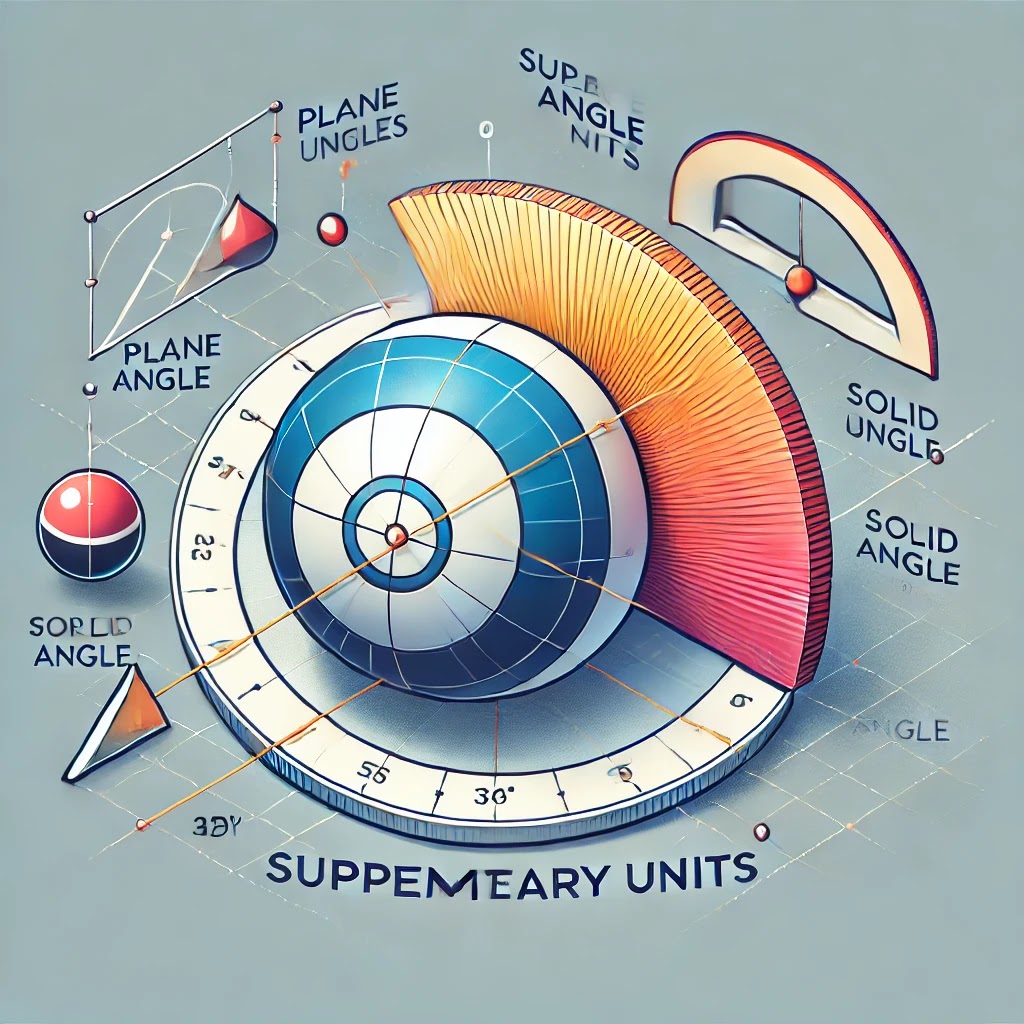
Supplementary units are a category of measurement units used in science, engineering, and commerce to describe certain physical quantities. They complement the base units and derived units in the International System of Units (SI). Supplementary units are primarily associated with two quantities: plane angle and solid angle.


  1. Plane Angle: Measured in radians (rad), plane angle represents the ratio of the length of an arc to its radius in a circle.

    • Formula: θ=arc lengthradius\theta = \frac{\text{arc length}}{\text{radius}}
    • Example: A full circle is 2Ï€2\pi radians.

  1. Solid Angle: Measured in steradians (sr), solid angle is a three-dimensional analog of the plane angle, representing the ratio of the area of a sphere's surface subtended by a cone to the square of the radius.

    • Formula: Ω=area on sphereradius2\Omega = \frac{\text{area on sphere}}{\text{radius}^2}
    • Example: A sphere has a total solid angle of 4Ï€4\pi steradians.

While these units are essential in fields such as geometry, astronomy, physics, and engineering, they have been integrated into derived units in the SI system. Therefore, they no longer form a distinct class of SI units but remain critical for understanding spatial measurements.


Here is an educational illustration representing the concepts of supplementary units: radians for plane angles and steradians for solid angles. It visually demonstrates the geometry of these measurements. Let me know if you need further assistance!

Saturday, 30 November 2024

History of the SI Unit System In Physics

History of the SI Unit System

The International System of Units, known as the SI (from the French "Système International d'Unités"), is the modern form of the metric system and the most widely used system of measurement in the world. Its history is deeply rooted in the quest for consistency and universality in scientific and commercial measurements. Here’s an overview of how this system evolved:


Origins: The Metric System

The SI system traces its roots to the late 18th century during the French Revolution. In 1790, the French Academy of Sciences was tasked with creating a standardized system of measurement to replace the disparate and often confusing systems in use. The resulting metric system was based on a decimal system, making calculations simpler and more uniform.


Key developments during this period include:

- The definition of the meter as one ten-millionth of the distance from the equator to the North Pole along a meridian.

- The kilogram, defined as the mass of one liter of water at the freezing point.

- The introduction of the second as a unit of time, originally derived from astronomical observations.

These units formed the foundation of the metric system, which quickly gained acceptance in France and eventually spread to other countries.


19th Century: Global Adoption and Refinement


Throughout the 19th century, the metric system continued to evolve and gain international acceptance. The need for an international standard became evident as global trade and scientific collaboration expanded. In 1875, the **Metre Convention** was signed by 17 nations, establishing the International Bureau of Weights and Measures (BIPM) to oversee measurement standards.


Key milestones include:

- The creation of physical prototypes for the meter and kilogram, made of platinum-iridium, which were kept as standards.

- The gradual adoption of the metric system by many countries, though some, like the United States, retained other systems alongside it.


20th Century: Birth of the SI System

By the mid-20th century, advances in science and technology demanded a more comprehensive and flexible system of units. In 1960, the 11th General Conference on Weights and Measures (CGPM) adopted the International System of Units (SI), building upon the metric system but incorporating new units and principles.

The SI system introduced:

Seven base units: meter (length), kilogram (mass), second (time), ampere (electric current), kelvin (temperature), mole (amount of substance), and candela (luminous intensity).

- Derived units, such as the newton for force and the joule for energy, formed by combining base units.

- A coherent system where all derived units are expressed as products of powers of the base units.

21st Century: Redefining the Base Units


In 2018, a landmark decision was made to redefine the SI base units based on fundamental constants of nature. This redefinition aimed to ensure greater precision and stability in measurements. For example:

- The kilogram, previously defined by a physical artifact ("Le Grand K"), is now defined using the Planck constant.

- The meter is defined by the speed of light in a vacuum.

- The second is defined by the vibrations of cesium atoms.


These changes represent the culmination of decades of scientific progress and international collaboration.


The SI System Today

Today, the SI system is used globally in science, industry, and commerce. It continues to evolve, with efforts to address emerging needs in technology and research. Its adoption underscores humanity's commitment to precision, consistency, and universality in measurement.


The history of the SI system highlights the importance of international cooperation and the ongoing pursuit of knowledge, making it an enduring cornerstone of modern civilization.


Wednesday, 27 November 2024

The Evolution of Physics: From Ancient Ideas to Modern Discoveries - Part 2

The Evolution of Physics: From Ancient Ideas to Modern Discoveries - Part 2

Building on the foundations laid in the first part of our journey through the history of physics, we continue to explore the monumental discoveries and transformative ideas that have shaped the field into what it is today. In this post, we will dive deeper into the 20th century and beyond, a period marked by revolutionary breakthroughs that have challenged our understanding of the universe.


The Quantum Leap: A New Era of Physics

At the dawn of the 20th century, the classical physics that had dominated for centuries began to crumble under the weight of new experimental evidence. The world of atoms and subatomic particles did not behave according to the predictable laws of Newtonian physics. Max Planck introduced the concept of quantized energy in 1900, which laid the groundwork for quantum mechanics. This theory proposed that energy exists in discrete units, or "quanta," rather than flowing continuously, forever altering how we understand the micro-world.

Following Planck, Albert Einstein revolutionized our understanding of the physical world with his theory of relativity, which challenged classical notions of space and time. His famous equation, E=mc², showed that mass and energy are interchangeable, leading to profound implications for our understanding of both the very small (particles) and the very large (the cosmos). Einstein’s theory of special relativity, published in 1905, forever altered our understanding of time, space, and the speed of light.

Meanwhile, in the quantum realm, Niels Bohr and Werner Heisenberg expanded on Planck’s and Einstein’s work, leading to the development of quantum mechanics. Heisenberg's uncertainty principle and Bohr’s model of the atom provided a new framework for understanding atomic structure and particle behavior, though their ideas often seemed at odds with everyday experiences. This paradoxical nature of quantum mechanics—where particles could exist in multiple states at once—fascinated and baffled scientists.

The Rise of Modern Physics: Expanding Frontiers

The second half of the 20th century ushered in even more groundbreaking discoveries that further pushed the boundaries of what we thought we knew. In 1964, Peter Higgs and others proposed the existence of the Higgs boson, a particle that gives other particles mass. This theory was confirmed in 2012 when scientists at CERN’s Large Hadron Collider discovered the elusive particle, marking one of the most significant achievements in the field of particle physics.

Simultaneously, the exploration of quantum field theory, string theory, and the nature of dark matter and dark energy began to push the boundaries of physics even further. These theories promise to offer answers to some of the deepest mysteries of the universe, such as the nature of gravity, the behavior of black holes, and the existence of parallel universes.

The Ongoing Search for Unified Theories

One of the most ambitious goals of modern physics is the search for a Theory of Everything (TOE)—a single framework that can explain and unify all fundamental forces of nature: gravity, electromagnetism, the weak nuclear force, and the strong nuclear force. While physicists have made significant progress, particularly with the development of string theory and quantum gravity, a complete TOE remains elusive.

Conclusion: The Future of Physics

The evolution of physics, from ancient speculation to cutting-edge theories, showcases the remarkable progress humanity has made in understanding the natural world. Today, physics is not just about understanding how the universe works—it is about exploring the very nature of reality itself. With the advent of new technologies, experimental techniques, and theoretical models, the future of physics holds immense potential, offering exciting opportunities to uncover the deepest mysteries of the cosmos and perhaps, even answer questions that have yet to be imagined.

As we continue to explore the universe at both the macroscopic and microscopic levels, physics remains at the forefront of scientific discovery, an ever-evolving field that continually challenges our understanding of the world and the very fabric of existence. 

INTRODUCTION TO HISTORY OF PHYSICS

The Evolution of Physics: From Ancient Ideas to Modern Discoveries

The history of physics is a fascinating journey that chronicles humanity’s quest to understand the fundamental laws governing the universe. It spans millennia, from the ancient philosophers' speculative musings to the sophisticated, data-driven theories of modern-day scientists. Throughout this journey, key discoveries and revolutionary thinkers have reshaped our perception of the physical world.


Ancient Foundations

The origins of physics can be traced back to ancient civilizations, where early thinkers like the Greeks laid the groundwork for natural philosophy. Figures such as Aristotle and Plato pondered the nature of matter and the cosmos. However, their views were more philosophical than experimental, focusing on ideas about motion, the elements, and the cosmos' order. Archimedes contributed foundational concepts related to mechanics, buoyancy, and levers, which would become essential for later developments in physics.

The Scientific Revolution

The real transformation of physics began in the 16th and 17th centuries, during the Scientific Revolution. In this period, the reliance on observation and experimentation started to supersede speculative philosophy. Pioneers like Nicolaus Copernicus challenged the geocentric model of the universe, proposing the heliocentric theory, which placed the Sun at the center of the solar system. Galileo Galilei, through his groundbreaking use of the telescope, observed the moons of Jupiter, providing evidence that not all celestial bodies orbit the Earth. Johannes Kepler further refined the heliocentric model, discovering that planets move in elliptical orbits.

But it was Isaac Newton who provided the framework that would dominate classical physics. His laws of motion and the law of universal gravitation, published in Philosophiæ Naturalis Principia Mathematica in 1687, unified the understanding of forces governing both earthly and celestial bodies. Newton’s work laid the foundation for much of classical mechanics and influenced countless developments in physics, engineering, and astronomy.

The Birth of Modern Physics

The 19th century ushered in a new era with the rise of electromagnetism and thermodynamics. Figures like James Clerk Maxwell unified electricity, magnetism, and light in his famous equations, paving the way for modern electrical engineering. Meanwhile, the study of heat and energy led to the formulation of the laws of thermodynamics, which govern the behavior of energy in systems.

At the turn of the 20th century, revolutionary breakthroughs shook the foundations of classical physics. Albert Einstein’s theory of relativity transformed our understanding of space and time, showing that both are not fixed but relative to the observer. In parallel, the development of quantum mechanics, led by physicists such as Max Planck and Niels Bohr, revealed the strange behavior of particles at the atomic and subatomic level. These theories not only altered our conceptualization of the universe but also led to technologies that power modern life, including semiconductors, lasers, and nuclear energy.

Conclusion

The history of physics is a story of persistent curiosity, experimentation, and the courage to challenge established norms. It has transformed our understanding of the universe, from the motion of the stars to the behavior of tiny particles. As we continue to probe the mysteries of dark matter, quantum entanglement, and the nature of time itself, the history of physics reminds us that the pursuit of knowledge is an ever-evolving journey, shaped by the minds of those who dare to ask the most profound questions.

Thursday, 14 November 2024

The AI Revolution: Shaping Tomorrow's World

        The Future of AI: Endless Possibilities

 Artificial Intelligence (AI) has evolved from a niche area of computer science into a transformative force reshaping industries, societies, and the way humans interact with technology. As AI continues to progress, the future holds an array of possibilities that could redefine life as we know it. Below are some key areas where AI is expected to have a profound impact:                      


Transforming Industries:

1. Healthcare: AI-assisted diagnosis, personalized medicine, and predictive analytics.

2. Education: AI-powered learning platforms, adaptive curricula, and virtual teaching assistants.

3. Finance: AI-driven trading, risk management, and fraud detection.

4. Transportation: Autonomous vehicles, smart traffic management, and route optimization.

5. Energy: AI-optimized energy consumption, renewable energy integration, and smart grids.


Enhancing Productivity:


1. Automation: AI-powered process automation, workflow optimization, and task management.

2. Virtual Assistants: AI-driven personal assistants, scheduling, and reminders.

3. Data Analysis: AI-accelerated data processing, insights, and decision-making.

Improving Quality of Life:


1. Smart Homes: AI-controlled lighting, temperature, and security systems.

2. Personalized Recommendations: AI-driven content suggestions, product recommendations, and advertising.

3. Accessibility: AI-powered tools for people with disabilities, language translation, and speech recognition.


Environmental Sustainability:


1. Climate Modeling: AI-driven climate prediction, monitoring, and mitigation strategies.

2. Resource Management: AI-optimized resource allocation, waste reduction, and recycling.

3. Sustainable Agriculture: AI-assisted crop management, precision farming, and yield optimization.


Potential Benefits:


1. Increased Efficiency

2. Improved Accuracy

3. Enhanced Decision-Making

4. Personalized Experiences

5. Economic Growth


Challenges and Considerations:


1. Job Displacement

2. Data Privacy and Security

3. Bias and Fairness

4. Ethics and Accountability

5. Regulatory Frameworks


Future Outlook:


As AI continues to advance, we can expect:


1. Increased Adoption

2. Improved Integration

3. Enhanced Capabilities

4. New Applications

5. Transformative Impact

The future of AI holds immense potential for growth, innovation, and improvement. However, it's crucial to address the challenges and considerations to ensure a responsible and beneficial AI-driven future.

Wednesday, 13 November 2024

THE IMPORTANCE OF AI IN PROGRAMMING FIELD

 The Importance of AI in Programming

Artificial Intelligence (AI) is transforming many industries, and programming is no exception. As developers face increasingly complex challenges, AI tools and techniques are emerging as game-changers, enabling more efficient and powerful coding practices. Here's why AI is becoming indispensable in the world of programming.


1. Automating Repetitive Tasks

One of the most obvious advantages of AI in programming is its ability to automate repetitive and time-consuming tasks. Tasks like code formatting, error detection, and bug fixing can be automated with AI-driven tools like linters and static analysis software. This allows developers to focus on more critical aspects of their projects, improving overall productivity and reducing the chances of human error.

2. Code Assistance and Generation

AI is revolutionizing the way code is written. Tools like GitHub Copilot and ChatGPT can suggest code snippets or even generate entire blocks of code based on a developer’s input. These AI-powered assistants help reduce the time spent on research and boilerplate coding, allowing developers to focus on creating innovative solutions.

3. Enhanced Debugging

Debugging is an essential but often tedious part of programming. AI-powered debuggers can analyze patterns in code and predict where errors are most likely to occur, making it easier to pinpoint and fix issues. By learning from vast datasets of code, these tools become more accurate over time, offering more intelligent suggestions and solutions.

4. Improved Code Quality

AI can analyze large codebases and identify areas where improvements can be made, such as optimizing performance or enhancing security. AI tools can suggest best practices, help refactor inefficient code, and even highlight potential vulnerabilities, ensuring higher-quality software.

5. Continuous Learning and Adaptation

AI in programming is constantly evolving. As AI learns from its interactions with developers, it adapts and improves, making it an invaluable tool for developers looking to stay ahead in a rapidly changing technological landscape.

In summary, AI is not just a passing trend in programming; it’s becoming an essential partner in developing efficient, high-quality, and innovative software solutions. As these tools continue to evolve, their impact on the world of programming will only grow.

Wednesday, 31 July 2024

STUDENT RESULT SYSTEM IN DMC FORM BY ROLL NO OR REGISTRATION NO IN PHP MYSQL WITH SOURCE CODE

FETCH STUDENT DMC BY ROLL OR REGISTRATION NO IN PHP WITH SOURCE CODE


The Student Result DMC (Detailed Mark Certificate) system offers a streamlined way for students to access their academic results using their Roll No or Registration No. This system, built with PHP, allows students to effortlessly retrieve their DMC online, eliminating the need for physical visits to educational institutions. By simply entering their unique identification number, students can view detailed information about their academic performance, including subject-wise grades and overall scores. 

The system ensures data security and accuracy, providing students with an official record of their achievements. Additionally, it enhances transparency and efficiency in the results distribution process, making it easier for students to access their records anytime and anywhere.

 The PHP-based implementation offers a user-friendly interface, ensuring that students of all technical backgrounds can navigate the system with ease. Overall, this system modernizes the traditional process of result distribution and enhances the convenience for both students and educational institutions.


HOW TO INSTALL IT :

  1. Download the Source Code from the Provided Link
  2. Extract the Zip file Once file Successfully Download
  3. Copy the folder and past it onto Xamp/htdocs/ if you are using Xamp server
  4. Create Database in localhost with name " studentresults "
  5. Upload the Sql file student_results.sql file into that database
  6. Run the Project with the URL   localhost/dmcgenerated


                                     Password :  umertech4you.blogspot.com


Friday, 26 July 2024

STUDENT RESULT SEARCH BY ROLL NO IN PHP MYSQL WITH SOURCE CODE

 
Student Result Search by Roll No in PHP

The ability to search for student results by roll number is a critical feature in educational management systems, providing both students and administrators with quick access to academic performance data. Implementing this functionality in PHP involves several steps, ensuring that the process is efficient, secure, and user-friendly.

Firstly, the database setup is crucial. A well-structured database containing students' records is essential. Typically, this database will have tables for storing student details, course information, and result data. Each student is assigned a unique roll number that serves as the primary key for identifying records.


How to Install and Use This Project:

Step-1 

   Download the Source code from the Download menu and Extract the file.

Step-2: 

 After Successful extraction of the file. Just make database in the localhost and connect it   Detail of the Database and related info will be given in the read.text file

Step-3:

 Upload the sql file to localhost and run your project as localhost/entrancesystem

Project File : entrancesystem.

Database     : entrance_results


                                  Password of the Zip file :   umertech4you.blogspot.com


Wednesday, 7 August 2019

What is Prandel Virus?

Prandel is one of the ransomware-type programs that are part of the Djvu ransomware family. This particular ransomware was discovered by Michael Gillespie. Typically, programs of this type prevent victims from accessing their data by encrypting them with strong encryption algorithms. Additionally, they create/display ransom notes that contain information on how pay the ransom. In this case such information can be found in the text file named "_readme.txt". Copies of this file are placed in folders that contain encrypted files. Prandel renames all encrypted files, it adds the ".prandel" extension. For example, it renames "sample.jpg" to "sample.jpg.prandel" and so on.
As explained in the "_readme.txt" file, Prandel encrypts files (photos, databases, documents, etc.) with the strongest encryption algorithm. In order to decrypt them, it is necessary to purchase a decryption tool and unique key that cost $980. However, cyber criminals who developed Prandel offer a 50% discount for people who will contact them in the first 72 hours after having their computers infected with this ransomware. Prandel developers can be reached via email (gorentos@bitmessage.ch or gorentos2@firemail.cc) or Telegram (@datarestore). They also offer a free decryption of one file that can be sent to them via one of the given emails or Telegram. However, even if cyber criminals actually have the tools that can decrypt encrypted files, they often do not send them. For this reason we recommend not to pay (or even contact) people who developed Prandel. Besides, there is an offline decryption tool that might be able to help to recover files for free. However, it usually works only if the computer was not connected to the Internet (or remote server used by cyber criminals was not responding) while ransomware was encrypting the files. Another way to recover files without having to buy any decryption tools from cyber criminals is to restore them from a backup that was (if was) created before the encryption.
Most programs of this type are designed to encrypt victim's files and make sure that they could not be used unless a ransom is paid (decryption tool or/and key is purchased). Typically, decryptions without interference of ransomware developers are impossible and victims are forced to pay the ransom (or lose their files). Most common differences between ransomware-type programs are encryption algorithms (symmetric or asymmetric) that they use to lock files and prices of decryption tools/keys. As a rule, the only way to avoid data and financial loss is to restore files from created backups. For this reason we recommend to always have data backed up and keep the backup on a remote server or unplugged storage device. Other examples of programs that are similar to Prandel are Q1GKovasoh and Lotej.

How did ransomware infect my computer?

It is unknown how cyber criminals spread Prandel, however, quite often malicious programs usually are distributed via spam campaigns, trojans, fake software updaters, various unreliable software (or file) download sources and unofficial activation ('cracking') tools. Very often ransomware and other malware developers send emails that contain malicious attachments or web links that lead to them. The main point is to trick recipients into opening them by disguising the email as important. Examples of files that they usually attach are Microsoft Office and PDF documents, archive files (like RAR, ZIP), executable files (like .exe), JavaScript and other files. Once opened (or/and executed), these malicious files infect computers with malware or other high-risk malware. Trojans are programs that can be used to spread malicious software too. When installed, they cause chain infections, in other words, they download and install malware. Fake (unofficial) software updaters infect systems when they download and install malware instead of the updates, fixes or exploit bugs and flaws of outdated software.
 Unreliable download sources such as P2P (Peer-to-Peer) networks, free file hosting websites, freeware download pages, unofficial sites and other sources often contain malicious files. Cyber criminals disguise them as harmless executables or other files that, if downloaded and opened, lead to installations of unwanted, malicious programs. Unofficial tools that supposed to activate installed software for free often cause installations of malware too. These tools are also known as 'cracking' tools, people use them to bypass paid activation.

Friday, 1 March 2019

SEARCH ENGINE OPTIMIZATION LESSON-2 (SEO)


A page's description meta tag gives Google and other search engines a summary of what the page is about (1). Whereas a page's title may be a few words or a phrase, a page's description meta tag might be a sentence or two or a short paragraph.
Google Webmaster Tools provides a handy content analysis section that'll tell you about any description meta tags that are either too short, long, or duplicated too many times (the same information is also shown for<title> tags). Like the <title> tag, the description meta tag is placedwithin the <head> tag of your HTML document.

<html>
<head>
<title>TECH | PRO COMPLETE COURSE OF SEO</title>
<meta name="description=" content="Brandon's Baseball Cards provides a
large selection of vintage and modern baseball cards for sale. We also offer
daily baseball news and events in">
</head>

<body>
WHAT ARE THE MERITS OF DESCRIPTION META TAGS ?

Description meta tags are important because Google might use them as snippets for your pages. Note that we say "might" because Google may choose to use a relevant section of your page's visible text if it does a good job of matching up with a user's query. Alternatively, Google might use your site's description in the Open Directory Project.Adding description meta tags to each of your pages is always a good practice in case Google cannot find a good selection of text to use in the snippet. The Webmaster Central Blog has an informative post on improving snippets with better description meta tags.


IN SUMMERY , THE MAIN GOAL OF ABOVE LESSON IS TO 

1-Accurately summarize the page's content

Write a description that would both inform and interest users if they saw your description meta tag as a snippet in a search result.

AVOID THESE 

1. Writing a description meta tag that has no relation to the content on the page
2. Using generic descriptions like "This is a web page" or "Page about TECH | PRO"
3. Filling the description with only keywords
4. Copying and pasting the entire content of the document into the description meta tag

2- Use unique descriptions for each page

Having a different description meta tag for each page helps both users and Google,especially in searches where users may bring up multiple pages on your domain (e.g. searches using the site: operator). If your site has thousands or even millions of pages, hand-crafting description meta tags probably isn't feasible. In this case, you could automatically generate description meta tags based on each page's content.

AVOID THESE 

 Using a single description meta tag across all of your site's pages or a large group of pages


Follow All Lessons and Apply it on Your Blog If You Have Done Its Good.If you are new in the blog please go on steps and do the directed as above taught
If Your Interest Has made in this Posts Please Do the Share and Give a Comment in Below Section.
If You Have Directly came Here without Know the Basic of This Lessons.

FOR PREVIOUS LESSON-1

START FROM THE BASIC 

SEARCH ENGINE OPTIMIZATION STARTER GUIDE


Wednesday, 27 February 2019

SEARCH ENGINE OPTIMIZATION LESSON-1 (SEO)


Indicate page titles by using title tags
A title tag tells both users and search engines what the topic of a particular page is.
  The <title> tag should be placed within the <head> tag of the HTML document (1).Ideally,
  you should create a unique title for each page on your site.


EXAMPLE-1


<html>
<head>
<title>TECH | PRO FULL COURSE OF GOOGLE SEO FOR BLOGGING</title>
<meta name="description=" content="TECH | PRO are creatively content bog brings you the latest lessons about SEO .How can we rank our blog through SEO Rules">
</head>
<body>


Page title contents are displayed in search results 

If your document appears in a search results page, the contents of the title tag will usually appear in the first line of the results (if you're unfamiliar with the different parts of a Google search result, you might want to check out the anatomy of a search result video by
Google engineer Matt Cutts, and this helpful diagram of a Google search results page). Words in the title are bolded if they appear in the user's search query. This can help users recognize if the page is likely to be relevant to their search


 1- Accurately describe the page's content


AVOID THE FOLLOWING CERTAIN
       1. Choosing a title that has no relation to the content on the page
       2. Using default or vague titles like "Untitled" or "New Page 1"

2-Create unique title tags for each page

Each of your pages should ideally have a unique title tag, which helps Google know how the page is distinct from the others on your site.

AVOID THIS ONE 

      Using a single title tag across all of your site's pages or a large group of pages

3-Use brief, but descriptive titles

Titles can be both short and informative. If the title is too long, Google will show only a portion of it in the search result.

AVOID THESE ONE

       1. Using extremely lengthy titles that are unhelpful to users  
       2. Stuffing unneeded keywords in your title tags
Practice on the above Structures and apply on All Posts made on Different Pages.If Your Interest Has made in this Posts Please Do the Share and Give a Comment in Below Section.
If You Have Directly came Here without Know the Basic of This Lessons.

So Starts From Basic